
What Materials Work Best for Injection Molding?
Choose injection molding materials from use conditions, not resin familiarity. A suitable-looking polymer may fail after moisture, cleaning, sustained load, or difficult flow. Another may meet targets but demand drying, corrosion protection, or costly cycle conditions.
A sound choice links product requirements, exact-grade data, part geometry, mold concept, and trial evidence. Family guidance builds a shortlist. Only a named grade, color, supplier, and validated process can support approval.
1. What Should a Material Brief Define Before Resin Screening?
A useful brief describes how a molded part must work, where it will operate, and which failures matter. Statements such as "strong plastic" or "heat resistant" leave too much room for interpretation. Replace them with load direction, duration, temperature, chemical contact, appearance, service life, and regulatory market. Add assembly methods, sterilization or cleaning cycles, electrical needs, and acceptable dimensional movement.
Start with this filter: separate mandatory requirements from preferences. A flame classification, food-contact authorization, or customer specification may control entry. Record every unknown as a test, question, or risk.
- Record normal, peak, and abnormal service conditions.
- Mark each requirement as mandatory, target, or open.
- Name who owns verification and which evidence will close it.
Action: Issue one controlled material brief before asking suppliers for grades.
Decision table: Material brief inputs
| Requirement area | Evidence needed | Weak input | Better input |
|---|---|---|---|
| Mechanical | Load, direction, duration, safety factor | Strong | Sustains defined load after conditioning |
| Thermal | Continuous and peak temperature, load state | Heat resistant | Peak exposure for stated time under load |
| Environment | Chemicals, humidity, UV, cleaning cycle | Chemical proof | Named fluid, concentration, time, temperature |
| Appearance | Color, gloss, texture, visible defects | Looks good | Approved plaque and viewing standard |
2. Which Resin Families Fit Common Injection-Molded Parts?
Resin families provide a screening map. Polypropylene often enters reviews for low density, hinge behavior, and chemical exposure. ABS commonly enters for appearance and balanced toughness. Polycarbonate may suit impact or transparency needs. Polyamides, polyesters, and acetal grades can support demanding mechanical, wear, or dimensional duties under defined conditions. TPE grades address flexible touch, sealing, or overmolding.

The useful distinction comes next: grades within one family can behave like different materials. Reinforcement, additives, viscosity, and color alter performance or processing. A family choice never authorizes a grade.
- Use family tendencies only for early elimination.
- Compare datasheets under matching test methods and conditioning.
- Ask for molded-part testing where several properties interact.
Action: Shortlist two or three exact grades against one shared requirement matrix.
Decision table: Resin-family screening
| Family | Often screened for | Watch closely | Approval evidence |
|---|---|---|---|
| PP | Low density, flexing, chemical exposure | Creep, low-temperature impact, shrinkage | Conditioned part tests |
| ABS | Surface quality, toughness, coloring | Weathering, solvent exposure, heat | Appearance and environment tests |
| PC and blends | Impact, transparency, heat options | Stress cracking, drying, molded stress | Chemical and impact validation |
| PA | Strength, wear, heat options | Moisture conditioning, shrinkage, drying | Dry and conditioned results |
| POM | Wear, friction, dimensional uses | Thermal history, contamination, bonding | Process and functional trials |
3. How Do Temperature, Chemicals, and Weather Narrow the Choice?
Service environment can eliminate a resin before strength data matters. Temperature must include time and load because brief peaks differ from sustained exposure. Chemical resistance also depends on fluid identity, concentration, temperature, contact time, and molded stress. A housing wiped with diluted cleaner faces another risk profile than a valve immersed under pressure.
Humidity may alter dimensions or strength for sensitive polymers. Outdoor use adds ultraviolet light, rain, and thermal cycling. Supplier charts support screening, while molded samples provide stronger evidence.
Conditions change each answer: one grade may pass an exposure and fail another.
- List every fluid, cleaner, lubricant, and assembly chemical.
- Test aged samples at realistic stress and temperature.
- Review color and additive packages as part of exact-grade identity.
Action: Build an exposure test plan from actual service and cleaning conditions.
Decision table: Environmental exposure screen
| Exposure | Missing detail that changes risk | Useful evidence | Decision outcome |
|---|---|---|---|
| Heat | Duration and applied load | Aged property data plus part test | Accept, derate, or reject |
| Chemicals | Concentration and stress state | Immersion or stressed-part trial | Confirm compatible window |
| Humidity | Conditioning level | Dimensional and mechanical results | Set conditioning controls |
| UV and weather | Geography and service duration | Weathering data and color target | Specify stabilization and test |
4. How Should Loads, Impact, Creep, and Wear Be Compared?
Single-point tensile values rarely describe a working part. A snap arm sees strain during assembly. A bracket carries sustained load. A gear combines contact stress, friction, heat, and wear. A dropped enclosure needs impact performance at its lowest service temperature. Each case calls for different evidence.
Creep deserves early attention because short-load performance may hide movement during service. Weld lines, moisture, fiber orientation, and molded stress can also reduce part performance.
Put the load into context: direction and duration matter as much as magnitude.
- Convert product use into static, cyclic, impact, and wear cases.
- Identify stress concentrations and weld-line locations.
- Test after heat, humidity, chemical, or aging exposure when relevant.
Action: Approve mechanical performance with conditioned molded parts, not neat-resin values alone.
Decision table: Mechanical evidence
| Duty | Screening property | Part-level concern | Validation approach |
|---|---|---|---|
| Sustained load | Creep or stress relaxation | Boss movement, seal loss | Loaded aging fixture |
| Impact | Notched impact at use temperature | Corners, weld lines, drops | Conditioned drop or impact test |
| Flexing | Fatigue and strain capability | Snap damage, living hinge | Repeated-cycle test |
| Sliding wear | Friction and wear data | Heat, noise, debris | Mated-component endurance test |
5. How Do Part Geometry and Mold Design Affect Material Behavior?
Material data cannot rescue every geometry. Injection mold engineering must account for how a named grade flows, shrinks, cools, and wears tooling. Thick transitions may sink or cool unevenly. Long thin walls raise pressure demand. Ribs and bosses can pull surfaces inward. Sharp corners concentrate molded stress locally. Gate position controls flow direction, weld lines, packing, and fiber orientation. Cooling layout then influences shrinkage and warpage.

Filled grades add another layer. Fiber orientation can make shrinkage and stiffness directional. Another compound may also shift steel dimensions, flow, or cooling needs.
Steel records every assumption: late resin changes can move dimensions, pressure, and cooling balance.
- Review material, geometry, gate, and cooling as one system.
- Flag thick sections, weak knit regions, and direction-sensitive dimensions.
- Confirm shrinkage with supplier data and trial measurements.
Action: Freeze exact material before final steel dimensions whenever project timing allows.
Decision table: Geometry and mold interactions
| Design feature | Material interaction | Mold implication | Evidence before freeze |
|---|---|---|---|
| Long flow path | Viscosity and freeze-off | Gate size and pressure demand | Fill study or short-shot trial |
| Thick transition | Cooling and local shrinkage | Packing and cooling balance | Sink and section review |
| Weld-line region | Flow-front temperature and bonding | Gate and vent placement | Functional weld-line test |
| Filled resin | Orientation and anisotropy | Shrinkage allowance | Directional measurements |
6. Which Processing Limits Matter on the Molding Floor?
Every candidate grade brings a processing envelope. Drying method, allowable moisture, melt range, mold temperature, shear sensitivity, residence time, screw design, and cooling demand can alter quality. These requirements must fit available equipment and control methods. A resin that needs disciplined drying or narrow residence control may still be right, but its operating burden belongs in selection.
Shot demand must suit barrel, pressure, and clamp capacity. Hot-runner volume, purging, and startup scrap also affect risk. Supplier settings remain a starting range, not a transferable recipe.
A datasheet cannot run the press: stable output needs a documented window around actual cavity behavior.
- Confirm drying and material-handling capability.
- Match shot, pressure, clamp, and temperature needs with equipment.
- Record fill, transfer, pack, cooling, and recovery limits during trials.
Action: Require a repeatable process window before production approval.
Decision table: Processing-window evidence
| Variable | Selection question | Trial evidence | Risk if ignored |
|---|---|---|---|
| Drying | Can moisture remain within supplier limit? | Dryer trend and moisture check | Splay, degradation, property loss |
| Melt and residence | Can equipment stay inside grade guidance? | Actual melt check and cycle history | Degradation or unstable flow |
| Mold temperature | Can circuits hold a balanced condition? | Surface or coolant trend | Finish and dimensional drift |
| Pressure demand | Does process retain usable margin? | Fill and cavity evidence | Short shots or flash |
7. When Do Fillers and Additives Help or Hurt?
Glass fiber, mineral, impact modifier, lubricant, flame package, UV stabilizer, colorant, and conductive filler each solve a defined problem. Each can also create a new constraint. Fiber raises stiffness for many grades yet may increase anisotropy, tool wear, visible flow patterns, or weld-line sensitivity. Lubricated compounds may improve wear while complicating bonding or painting.
Color packages may influence appearance, shrinkage, weathering, or compliance scope. Regrind adds heat history and contamination risk. Treat each modified or colored grade as a separate material.
Ask what the modifier buys: every addition needs a measurable job.
- Link each filler or additive with one requirement.
- Review downstream joining, finishing, and recycling effects.
- Test exact color and allowed regrind percentage in production conditions.
Action: Reject any modifier whose benefit lacks a matching acceptance test.
Decision table: Modification tradeoffs
| Modification | Intended benefit | Possible tradeoff | Required check |
|---|---|---|---|
| Glass fiber | Stiffness, dimensional support | Orientation, wear, surface | Flow-direction dimensions |
| Mineral fill | Shrinkage or stiffness control | Density, toughness, finish | Weight and impact test |
| Impact modifier | Toughness | Stiffness, heat, flow | Use-temperature impact |
| Flame package | Required fire behavior | Processing, color, mechanics | Exact-grade recognition scope |
8. How Should Compliance and Traceability Be Verified?
Compliance belongs to an exact application. Broad labels such as "food grade," "medical grade," or "UL material" omit conditions that may control acceptance. Review market, contact type, temperature, duration, wall thickness, color, supplier, and formulation. Some authorizations attach to a manufacturer or defined use, so a similar polymer cannot inherit them automatically. For a concrete ESD-sensitive application, IC tray material selection shows why use conditions matter.
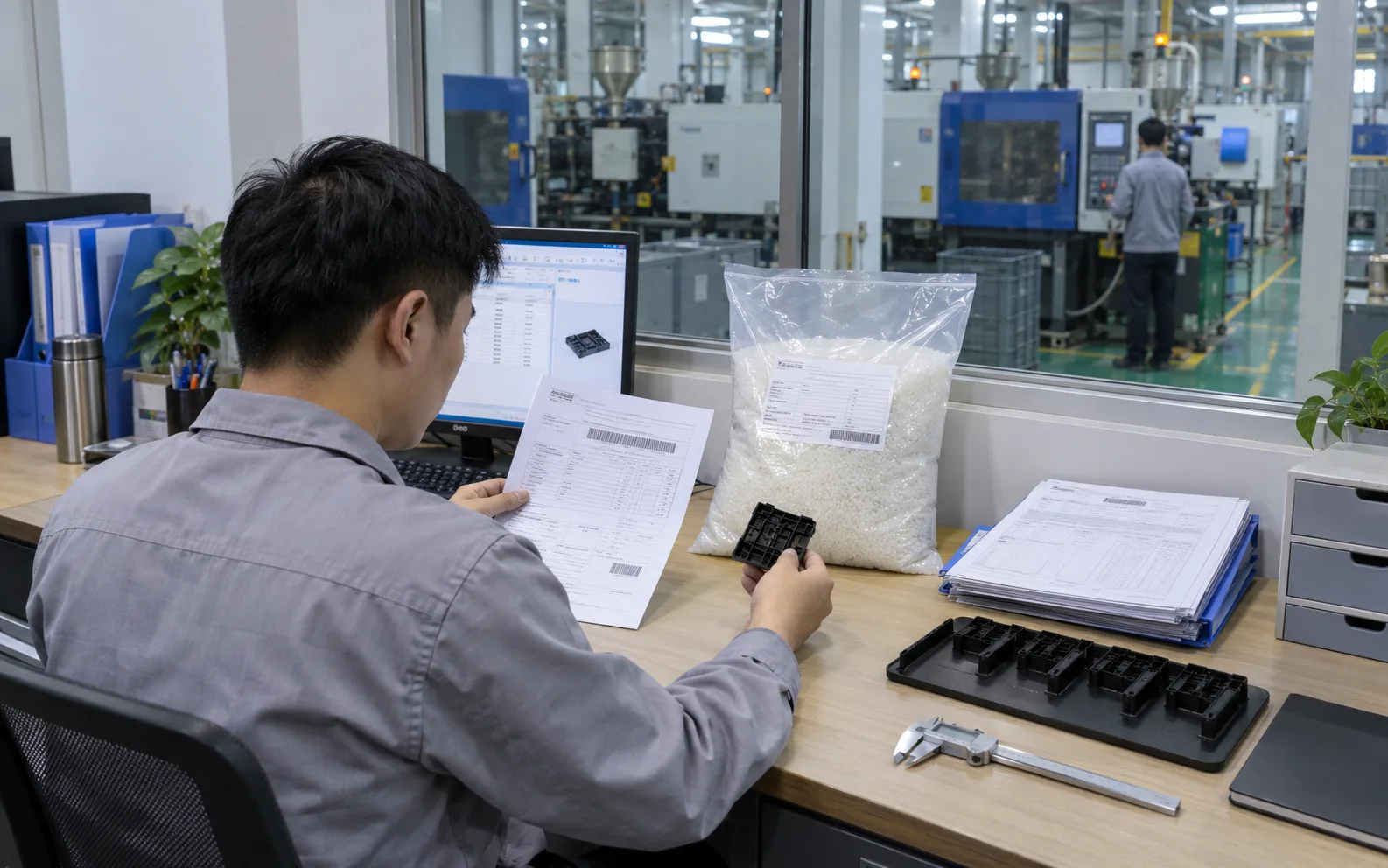
Traceability should connect purchase, lot, processing batch, and finished parts. Supplier changes can invalidate prior evidence. Qualified owners must review legal and customer requirements.
Paperwork follows the pellet: missing identity breaks any credible approval chain.
- Verify current documents for exact grade and color.
- Match each statement with target market and use condition.
- Define lot records, retention, and supplier change notice.
Action: Quality should sign a compliance matrix before commercial release.
Decision table: Compliance evidence
| Requirement | Verify against | Evidence to retain | Common gap |
|---|---|---|---|
| Flammability | Grade, color, thickness, rating scope | Current recognition record | Family name used as proof |
| Food contact | Substance, supplier, food type, use condition | Authorization and declaration | Generic food-grade claim |
| Chemical restrictions | Market and current substance list | Supplier declaration and review date | Expired declaration |
| Customer specification | Drawing and approved source | Signed material approval | Uncontrolled substitution |
9. How Should Cost and Supply Risk Enter the Decision?
Pellet price covers only one line in molded-part cost. Material density changes molded part mass. Flow may affect wall feasibility or pressure margin. Cooling can move cycle time. Abrasive fillers may alter maintenance. Scrap, startup, purging, drying energy, inspection, secondary work, and qualification all belong in comparison.
Supply continuity risk needs direct evidence. A single-source grade may suit a stable program with strong inventory controls. Any alternate still requires separate technical and compliance approval.
Run the full ledger: cheap resin can produce an expensive part.
- Compare cost per accepted part at stable production.
- Include qualification, scrap, cycle, energy, and tooling effects.
- Approve alternate sources before a shortage forces the decision.
Action: Purchasing and engineering should sign one total-cost and continuity review.
Decision table: Total-cost and supply comparison
| Cost or risk | Evidence | Comparison basis | Approval question |
|---|---|---|---|
| Material | Price, density, usage | Cost per molded part | Does mass offset unit price? |
| Conversion | Cycle, drying, scrap | Cost per accepted part | Does process remain stable? |
| Tooling | Wear, deposit, maintenance | Planned service burden | Does compound change upkeep? |
| Quality | Inspection and rejection | Cost of control and failure | Which evidence reduces escape risk? |
10. How Should a Team Approve the Final Resin Grade?
Approval should move through gates. Requirements precede screening, while molded trials precede release. A final record names manufacturer, grade, color, additives, regrind limit, source, process window, tests, and deviations.
Close every open loop: an isolated material code leaves future teams guessing.
- Confirm all mandatory requirements with controlled evidence.
- Validate dimensions, appearance, assembly, and function after conditioning.
- Freeze material identity, process baseline, and change-control owners.
Action: Release one named grade only after part tests, compliance review, and stable production evidence agree. Send your 3D model, use environment, annual demand, and mandatory standards with an RFQ so mold and material reviews begin from the same brief.
Frequently Asked Questions
FAQ 1: Can a resin family be approved without naming a grade?
No, because approval requires an exact grade. Commercial grades differ in viscosity, additives, reinforcement, color, and authorization scope. Approval needs a named grade, supplier, and defined use conditions.
FAQ 2: Can regrind be added after a virgin material passes testing?
Only through controlled material validation. Check percentage, contamination, heat history, appearance, performance, and compliance. Record any approved limit in material and process specifications.
FAQ 3: Does a medical application require a so-called medical-grade resin?
Application risk, patient contact, sterilization, market, traceability, and supplier controls determine evidence needs. A marketing label cannot close that review.
FAQ 4: Does changing color require another molding trial?
Often yes, because color packages can differ. Pigment and carrier changes may affect appearance, flow, shrinkage, weathering, or compliance scope. Match trial depth with product risk.
FAQ 5: Can purchasing substitute a similar grade during a shortage?
Treat substitution as a controlled change. Compare compliance, shrinkage, processing, color, and part performance before production use.