
What Drives Injection Mold Cost?
An injection mold cost cannot be judged from part appearance alone. A compact housing may hide side actions, tight shutoffs, textured surfaces, or demanding inspection work. Two suppliers can also quote different scopes under similar totals. Buyers need a controlled RFQ, transparent cost breakdown, and common acceptance rules.
1. What Does an Injection Mold Cost Actually Include?
A tooling price should describe a defined package, not one unexplained number. Core construction usually covers design, mold materials, standard components, machining, fitting, assembly, and agreed trials. Other items may sit outside that figure. Common examples include molding resin, dimensional reports, sample freight, export packing, duties, spare parts, or production transfer support.
Start with scope, because price follows scope. A low figure can become expensive once missing work returns through change orders. Ownership also needs plain wording. Specify who owns design data, spare inserts, electrodes, trial records, and physical tooling after payment.
Review these items before comparing totals:
- Included design reviews and mold drawings
- Steel, mold-base, runner, and component specifications
- Trial rounds, sample quantities, and inspection reports
- Packing, transport, taxes, duties, and installation support
- Acceptance criteria, warranty terms, and change-control rules
Action: Require every supplier to mark each RFQ line as included, excluded, optional, or pending clarification.
Quote-scope checkpoint
| Scope block | Buyer should define | Evidence expected in quote |
|---|---|---|
| Tool build | Configuration, cavities, steel, actions, runner | Named specifications and assumptions |
| Validation | Trial conditions, samples, measurements | Trial plan and report list |
| Delivery | Tool location, packing, freight, handover | Incoterm or delivery boundary |
| Support | Spares, repair response, transfer documents | Included support and rate basis |
2. Which Part Features Push Tooling Cost Up?
Part geometry determines much of the work inside a mold. Projected area and depth influence tool size. Undercuts can require slides, lifters, collapsible features, or design changes. Fine texture, sharp shutoffs, thin steel conditions, and deep ribs demand more machining or hand fitting. Critical dimensions may also add inspection fixtures, sampling effort, and correction loops.
A feature earns its cost through work. Ask suppliers to connect each surcharge with an operation, component, or risk. This request exposes different interpretations. One bidder may assume a bypass shutoff while another includes a driven slide.
Flag these geometry items during DFM review:
- External and internal undercuts
- Deep ribs, bosses, pockets, and narrow slots
- Cosmetic surfaces, texture boundaries, and gate restrictions
- Inserts, threads, seals, or post-molding interfaces
- Critical dimensions tied to assembly or function
Action: Freeze a marked-up geometry review before commercial comparison, with every action and critical surface identified.
Feature-to-cost checkpoint
| Part feature | Tooling work created | Quote question |
|---|---|---|
| Undercut | Moving action, travel control, fitting | Which release method was priced? |
| Deep feature | Long-reach machining, polishing, cooling limits | What access and cooling method applies? |
| Cosmetic face | Gate, texture, polish, handling controls | Which finish standard was assumed? |
| Critical dimension | Steel-safe strategy, measurement, correction | How will approval be measured? |
3. How Do Cavities and Annual Volume Change the Budget?
Cavity count links tooling investment with output demand. More cavities can produce more parts per cycle. Yet a larger mold may need a bigger machine, complex feed system, and tighter balance control. Part size, shot volume, clamp force, production schedule, and expected demand all affect a workable choice.
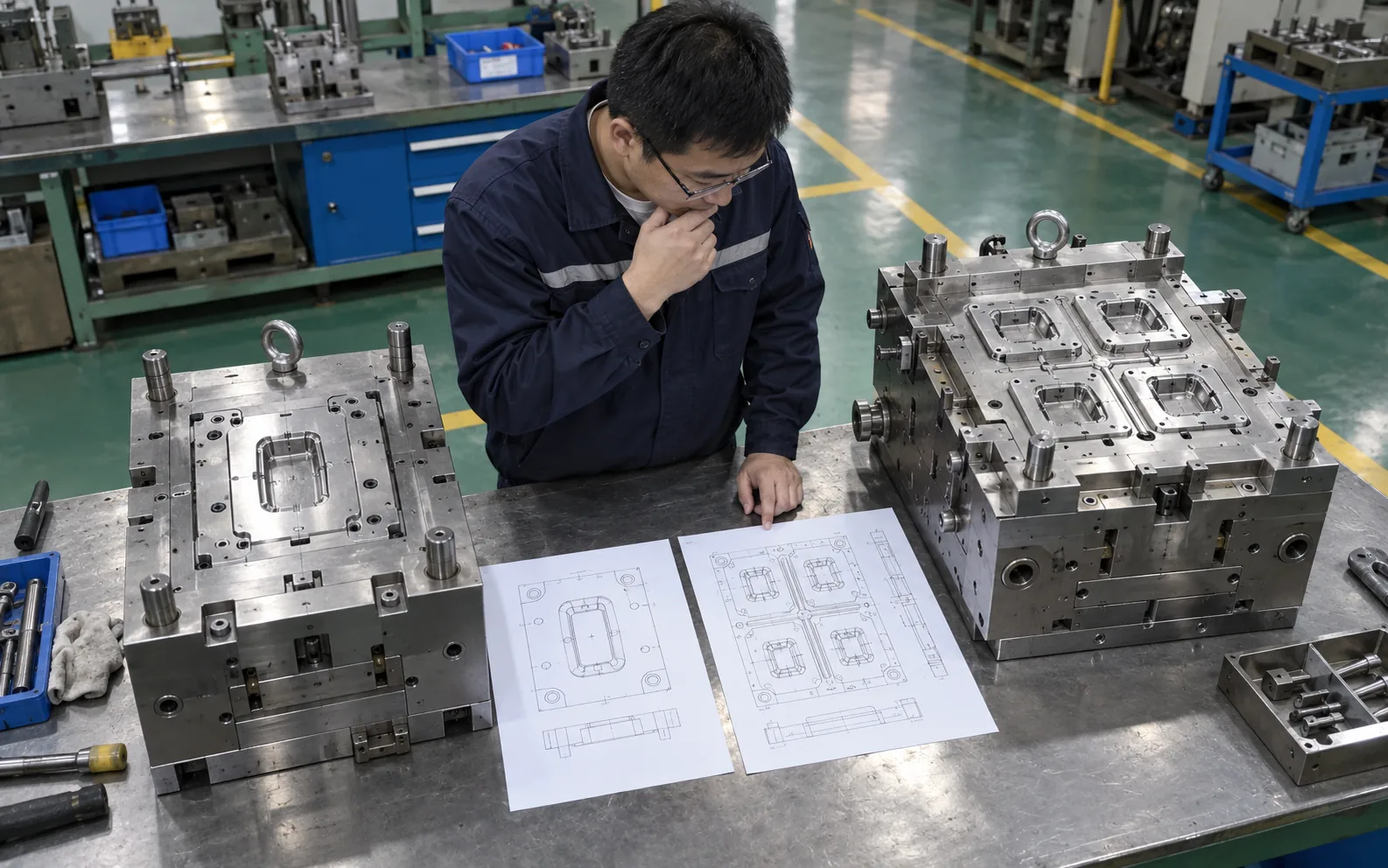
Volume alone does not choose cavity count. Demand stability also affects selection. A high-cavity tool may suit one mature part, while uncertain demand can favor a smaller launch tool or staged capacity plan. Family molds need extra care because unequal parts can fill, cool, or eject differently.
Test each proposal against these constraints:
- Forecast by launch, normal, and peak demand
- Available molding-machine capacity and shot size
- Runner balance, cavity balance, and inspection burden
- Downtime impact if one tool carries all output
- Expansion route through duplicate or modular tooling
Action: Ask for a capacity calculation and machine assumption beside every cavity recommendation.
Cavity-decision checkpoint
| Option | Upfront effect | Operating implication | Best question |
|---|---|---|---|
| Single cavity | Lower complexity | Lower output per cycle | Does launch demand justify expansion later? |
| Multi-cavity | Higher build and balance work | More output per cycle | Can machine and process hold balance? |
| Family mold | Shared tool for different parts | Scheduling and balance become linked | Are part demand ratios stable? |
| Duplicate tools | Added capital and qualification | Capacity and continuity improve | Does supply risk justify duplication? |
4. How Do Steel, Mold Base, and Components Affect the Quote?
Material choices should follow actual duty. Resin chemistry, fillers, finish, expected production, cooling layout, corrosion exposure, and repair strategy can point toward different steels or treatments. A generic label such as “hardened steel” gives procurement little control. Exact grade, hardness condition, source, and treatment matter.
Specification beats reputation at this stage. Mold bases, guide elements, seals, springs, connectors, and hydraulic parts also affect interchangeability and service access. Named standards help a receiving plant stock compatible spares. Approved alternatives prevent silent substitutions.
Put these fields into an RFQ schedule:
- Insert and plate material grades
- Heat treatment, coating, and hardness targets where needed
- Mold-base standard and key component brands
- Water, electrical, hydraulic, and pneumatic connections
- Spare-part list plus approved substitution process
Action: Reject vague material descriptions and request traceable specifications for every critical insert or wear component.
Specification-control checkpoint
| Item | Weak quote wording | Controlled wording should include |
|---|---|---|
| Cavity insert | Tool steel | Grade, condition, treatment, hardness target |
| Mold base | Standard base | Standard, size, plate material, supplier |
| Wear component | Equivalent brand | Part number or approved alternative process |
| Connection | Customer standard | Type, size, position, and labeling rule |
5. When Do Slides, Lifters, and Hot Runners Earn Their Cost?
Slides and lifters release features that cannot move along normal mold opening direction. Their value depends on geometry and part redesign options. Each moving action needs travel, support, guidance, lubrication, sensing, or maintenance access. Simpler geometry often reduces tooling price and future service work.
Hot runners keep polymer molten within a heated feed system. They can reduce cold-runner material and some degating work. Yet controls, heaters, thermocouples, nozzles, valve hardware, and service procedures add capital plus maintenance demands.
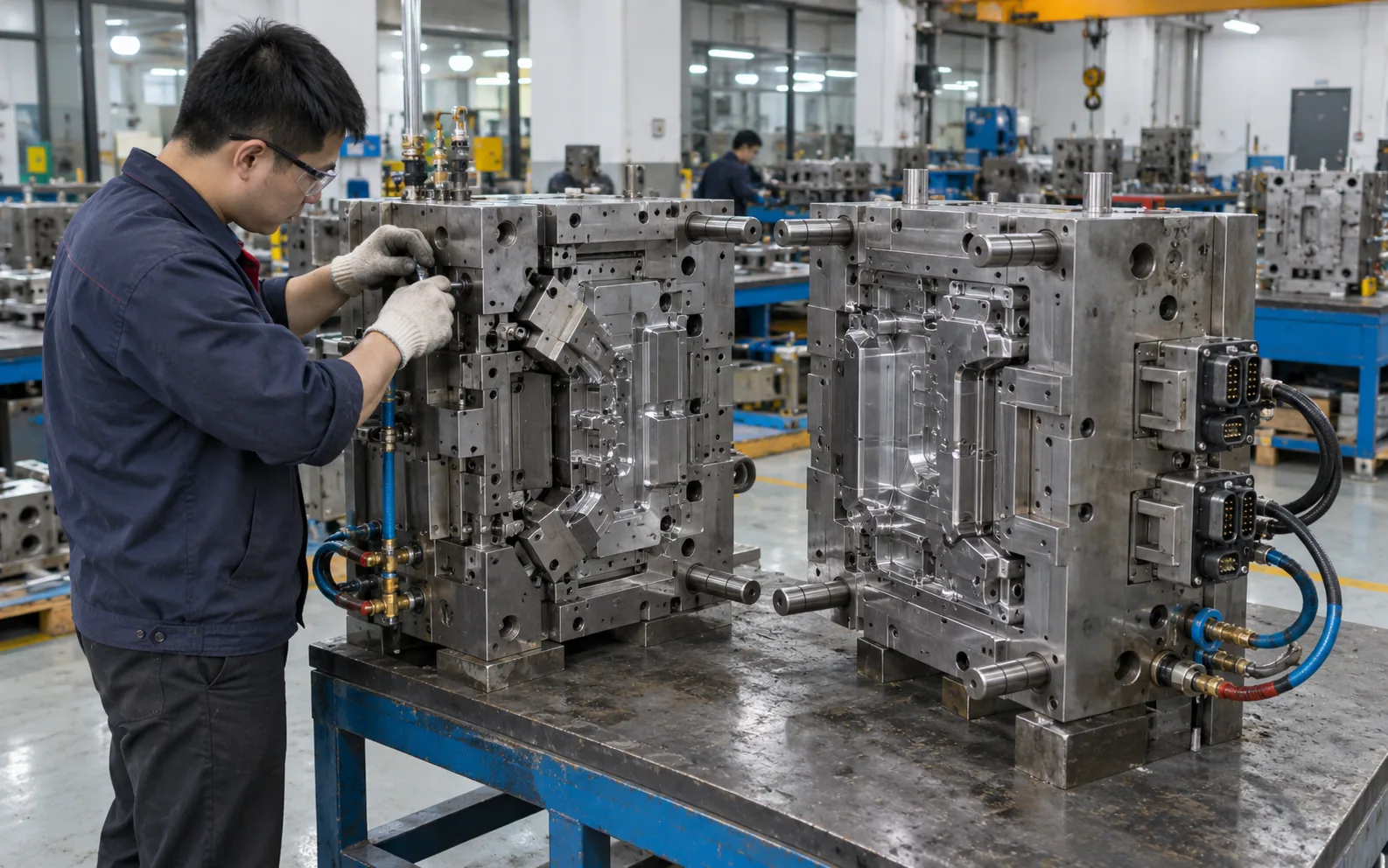
Mechanisms need an operating case, not a sales label. Evaluate output, resin cost, changeover frequency, cosmetic needs, automation, and local service capability together.
Ask suppliers to explain:
- Which undercut forces each moving action
- How actions are guided, sensed, and serviced
- Why a cold or hot runner fits production conditions
- Which controller and connector standards apply
- What spares and restart procedures are expected
Action: Approve each mechanism only after its production benefit and service burden appear in writing.
Mechanism trade-off checkpoint
| Mechanism | Potential benefit | Added burden | Approval basis |
|---|---|---|---|
| Slide | Releases external undercut | Wear, alignment, travel control | Geometry cannot be simplified |
| Lifter | Releases internal undercut | Thin sections, timing, fitting | Ejection path remains reliable |
| Hot runner | Less cold-runner material | Controls, heat, service skill | Production case supports added system |
| Valve gate | Gate control and sequencing | Actuation, sensing, maintenance | Fill or surface need is documented |
6. How Much Validation Should the Tooling Quote Cover?
Validation scope can change a quote materially. Define how many planned trials belong in base price, who supplies resin, which machine runs each trial, and how many samples each team receives. Measurement scope needs equal precision. A basic sample report differs from a full dimensional layout, material test, or process study.

A sample is evidence only under known conditions. Record resin grade, lot status, machine, mold temperature, process settings, cavity identity, and inspection method. Otherwise, buyers cannot judge whether later production matches approval conditions.
Define these validation deliverables:
- Trial purpose and entry criteria
- Resin source, drying responsibility, and quantity
- Sample quantity by cavity
- Measurement plan, gauge method, and report format
- Issue log, correction responsibility, and approval signature
Action: Attach a validation matrix to the RFQ and price optional studies separately from basic tool acceptance.
Validation-scope checkpoint
| Deliverable | Scope variable | Commercial boundary |
|---|---|---|
| Trial | Count, duration, machine, resin | Included rounds versus added trials |
| Samples | Quantity, cavity traceability, shipping | Included set and freight owner |
| Inspection | Features, method, report format | Basic report versus full layout |
| Correction | Workmanship issue or design change | Responsibility and approval route |
7. Which Costs Often Appear After the Purchase Order?
Tooling programs change after release through revised geometry, resin choices, or receiving-plant connector requests. Those decisions need controlled commercial treatment. Without a baseline, every discussion becomes an argument about original scope.
Other exposure comes from freight, duties, insurance, lifting hardware, installation, spare inserts, maintenance, repair, and mold transfer. Buyers may also need design files, setup sheets, diagrams, spare-part drawings, or process records.
Later cost starts with an undefined boundary. A disciplined purchase order names each trigger, approval owner, and rate basis before work begins.
Review likely post-order items:
- Buyer-driven geometry or material changes
- Extra trials, samples, measurement, or expedited freight
- Replacement wear parts and consumables
- Transfer preparation, lifting, packing, and customs documents
- On-site launch support or receiving-plant modifications
Action: Establish a signed baseline plus written change authorization before steel cutting starts.
Post-order exposure checkpoint
| Cost trigger | Control document | Buyer decision |
|---|---|---|
| Engineering change | Revision notice and impact quote | Approve cost and schedule effect |
| Extra validation | Added trial request | Confirm evidence needed |
| Tool transfer | Handover checklist | Confirm data, spares, packing, condition |
| Production support | Service scope and rates | Define remote or on-site boundary |
8. How Can Buyers Normalize Competing Mold Quotations?
Issue one controlled RFQ pack. Use how to compare tooling quotations as a scope reference before reviewing totals. It should contain identical CAD, drawings, resin data, volume scenarios, quality requirements, machine constraints, and delivery expectations. Then require one response format. Free-form proposals hide gaps because suppliers place assumptions in different locations.
Comparable totals need comparable promises. Normalize currencies, taxes, freight, cavity count, runner type, steel, actions, validation, and spares. Record each deviation instead of forcing a false ranking. A higher quote may include more complete validation or stronger handover data.
Build a bid sheet with these columns:
- Requirement and source revision
- Supplier response
- Included price
- Optional price
- Exclusion or assumption
- Technical evidence and open action
Action: Hold a joint procurement-engineering review before selecting a commercial winner.
Quotation-normalization checkpoint
| Comparison field | Normalize to | Warning sign |
|---|---|---|
| Tool concept | Same cavities, actions, runner | Concept differs without explanation |
| Materials | Named grades and treatments | Generic steel descriptions |
| Validation | Same trials, samples, reports | “Samples included” without scope |
| Delivery | Same location and commercial boundary | Freight or duties left unclear |
| Support | Same spares and handover package | Ownership or data access omitted |
9. How Should Total Cost of Ownership Shape the Budget?
Purchase price covers one stage. Production economics also include molding time, runner material, scrap exposure, maintenance labor, spares, changeovers, downtime, energy, and transfer risk. These values depend on real operating conditions, so one generic lifetime claim adds little confidence.
Model several demand and process scenarios instead. Use agreed assumptions for annual quantity, cycle demand, cavities, material use, planned maintenance, and likely changeovers. Keep tool depreciation separate from piece-price estimates so each input remains visible.
The useful number has assumptions behind it. Sensitivity matters more than false precision. Test what happens when demand falls, scrap rises, one cavity stops, or a hot-runner repair interrupts production.
Include these cost buckets:
- Tooling, validation, and transfer
- Machine time, labor, material, and runner handling
- Inspection, maintenance, and replacement parts
- Changeover, downtime, and supply-continuity exposure
- End-of-program storage, repair, relocation, or disposal
Action: Compare supplier concepts through one shared TCO model with editable assumptions.
TCO checkpoint
| Cost bucket | Required input | Scenario test |
|---|---|---|
| Capital | Tool, validation, spares, transfer | Launch volume misses forecast |
| Conversion | Cycle, cavities, machine, labor | Cycle demand changes |
| Material | Part, runner, scrap assumptions | Resin cost or scrap shifts |
| Reliability | Maintenance, repair, downtime | One cavity or system fails |
10. What Should You Send for a Quotable Tooling Budget?
A supplier can only price what your team defines. Send native 3D data, a controlled 2D drawing, specified resin, finish requirements, forecast scenarios, cavity preference, critical dimensions, and acceptance plans. State where tooling will run plus any machine, connector, automation, or mold-base constraints.
Good RFQs remove guessing before negotiation begins. Include commercial requirements for ownership, confidentiality, payment stages, packing, delivery, support, and change control. Mark uncertain fields openly; operating scenarios give suppliers more value than a false single-point forecast.
Prepare this RFQ set:
- CAD and drawings under one revision
- Resin, color, additive, and regulatory requirements
- Annual demand plus launch and peak scenarios
- Critical quality, cosmetic, and assembly criteria
- Trial, inspection, documentation, and delivery scope
- Machine interface and receiving-plant standards
Action: Release one package to all bidders and close technical deviations before comparing final totals.
Frequently Asked Questions
Q1: Can a supplier estimate injection mold cost before final CAD exists?
Yes, as a budgetary estimate with stated assumptions. Treat that figure as a planning input and request a new quote after geometry, resin, volume, and acceptance scope stabilize.
Q2: Why is the cheapest mold quote often hard to compare?
Lower totals may omit trials, inspection, hot-runner controls, spares, freight, or documentation. Normalize scope before judging value.
Q3: Does a higher cavity count always reduce total cost?
No, because output may rise while tool size, balance work, machine requirements, maintenance, and downtime exposure also change.
Q4: Who should own an injection mold after payment?
Ownership depends on contract terms. State ownership, possession, design-data rights, transfer access, and disposal authority in purchase documents.
Q5: How long should an injection mold quotation remain valid?
Validity should match supplier terms and current material, component, freight, and currency conditions. Ask bidders to state an expiry date plus any adjustable inputs.