
Hot Runner vs Cold Runner: Which Should You Choose?
Runner selection affects material use, mold cost, startup behavior, maintenance work, and every color change after launch. A cheap tool can become expensive during production when each shot creates a heavy runner. A sophisticated system can also lose money when demand stays low or technicians cannot support it. This hot runner vs cold runner injection molding guide gives buyers a practical decision path. Compare both options against one production scenario, using approved resin, annual demand, runner mass, changeover frequency, downtime risk, and service capability.
1. What Separates a Hot Runner From a Cold Runner?
A cold runner cools with each shot, then leaves beside or attached to molded parts. Operators or automation must separate it. A hot runner uses heated channels so melt remains inside its feed system between cycles. Parts leave without a full runner, though gate vestige may remain.
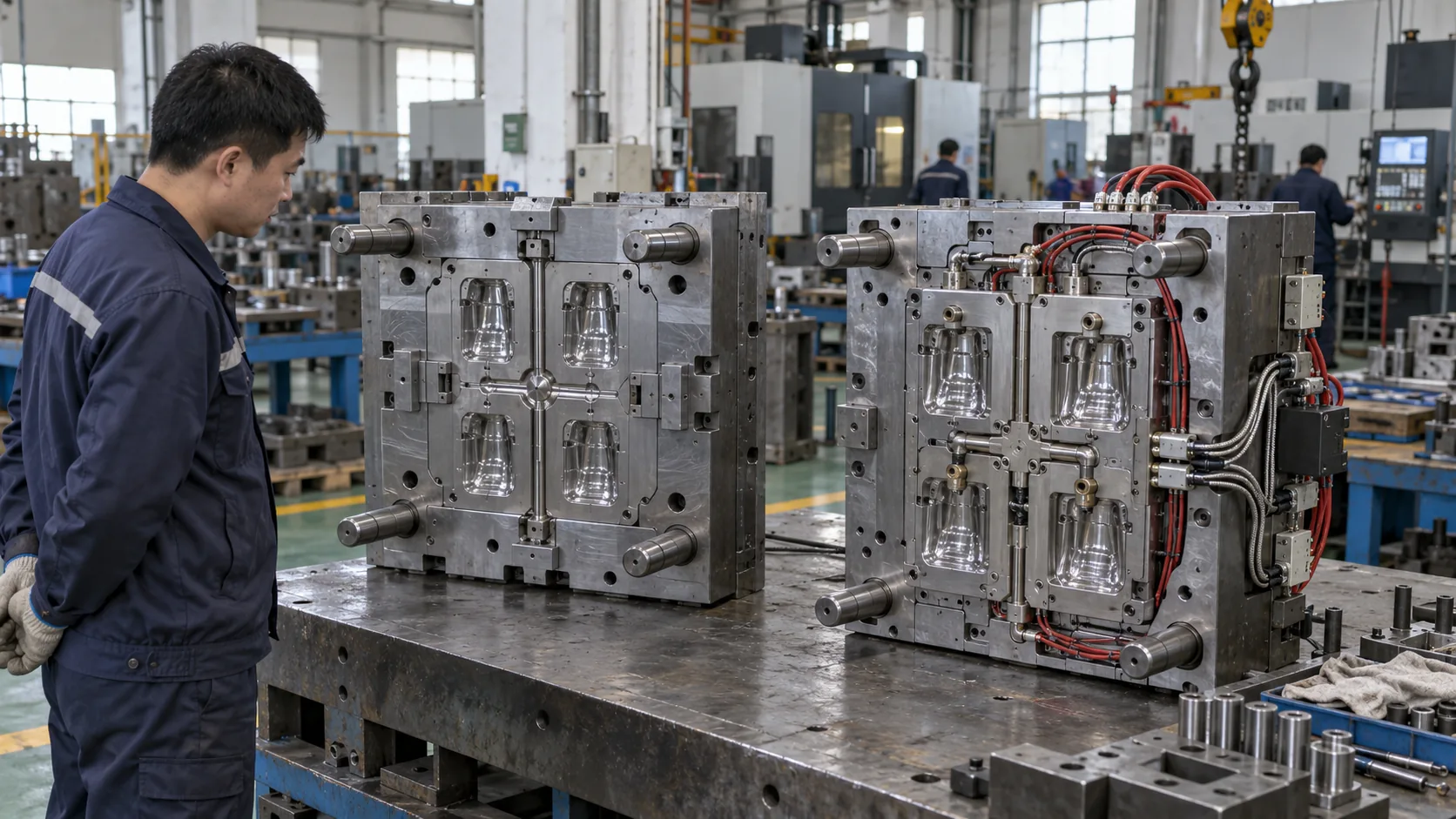
Start with what leaves the mold. That difference drives most commercial tradeoffs. Cold-runner tools usually offer simpler construction, easier access, and lower initial complexity. Hot-runner tools add manifolds, heaters, thermocouples, wiring, nozzles, controls, and thermal interfaces.
Review these items before discussing brands or nozzle styles:
- Part and runner mass per shot
- Planned cavities and gate locations
- Approved resin grade and color program
- Available press, controller, and maintenance support
- Annual volume plus expected program life
Action recommendation: Ask for two mold concepts on one shared production brief whenever either system looks feasible.
Which baseline differences should buyers compare?
| Decision area | Cold runner | Hot runner | Buyer implication |
|---|---|---|---|
| Feed path | Solidifies and ejects | Stays molten in heated channels | Changes material and handling economics |
| Tool construction | Fewer thermal components | Adds controlled heated hardware | Raises design and service demands |
| Change access | Runner exposes each cycle | Melt remains inside manifold | Alters purge and contamination work |
| Best fit signal | Flexible, lower-volume programs | Repeated volume with costly runner loss | Requires project-specific payback |
2. How Does Production Volume Change the Choice?
Volume changes how often savings repeat. Across many shots, runner mass becomes a material stream requiring purchase, handling, reprocessing, or disposal. Hot-runner economics often improve as annual shots rise.
Shot count does the talking here. Annual part demand can mislead when cavity counts differ. Divide annual demand by saleable parts per shot. Then account for startup scrap, samples, rejects, and production years.
Volume review should include:
- Annual saleable demand and peak-month demand
- Cavities producing acceptable parts per cycle
- Planned service life measured in production years
- Demand uncertainty and product-revision risk
- Duplicate molds or geographic production plans
Cold runners often suit pilot builds, uncertain launches, or low-volume variants. Hot runners deserve review when stable demand and repeated runner loss create credible savings.
Action recommendation: Model low, expected, and high demand instead of approving tooling from one optimistic forecast.
Which volume signals point toward each system?
| Program signal | Cold-runner direction | Hot-runner direction | Question before approval |
|---|---|---|---|
| Short program | Limits capital exposure | May not recover added tool cost | How many paid shots are credible? |
| Stable repeat orders | Runner cost repeats | Savings can accumulate | What program life has approval? |
| Demand uncertainty | Preserves flexibility | Adds stranded-capital risk | What happens if demand halves? |
| High cavity count | Runner may become large | Direct drops may cut feed scrap | Can every cavity fill consistently? |
3. How Should Resin Behavior Affect Runner Selection?
Resin choice can overrule a financial answer. Polymer remains hot inside a manifold during cycling, pauses, and shutdown. Excessive temperature, long residence, or stagnant flow can degrade some grades, causing specks, odor, or unstable molding.
Material names are too broad. Base, flame-retardant, glass-filled, transparent, and custom grades can behave differently. Request current grade-specific processing guidance. Confirm hot-runner suitability and flow paths without hang-up areas.
Material review should cover:
- Recommended melt range and allowable residence behavior
- Filler content, abrasion, and gate wear
- Moisture control and shutdown procedure
- Shear sensitivity or risk from narrow restrictions
- Color, additive, and contamination requirements
- Permission for regrind from a cold-runner system
A cold runner still carries material risk. Repeated regrind or poor segregation can create variation. Follow each material stream from sealed bag through accepted part.
Action recommendation: Require written grade-specific processing assumptions in both runner proposals.
How should material evidence change the decision?
| Material factor | Cold-runner concern | Hot-runner concern | Evidence needed |
|---|---|---|---|
| Heat sensitivity | Regrind history | Residence and stagnant zones | Supplier processing guide |
| Abrasive filler | Runner grinding and reuse | Tip and gate wear | Wear strategy and service plan |
| Transparent grade | Contamination from regrind | Degraded specks or streaks | Purge trial and cosmetic standard |
| Restricted regrind | Virgin resin loss | Added thermal hardware | Approved material-flow map |
4. How Much Runner Waste Will Each System Create?
Cold-runner waste starts with runner mass per shot. Multiply it by annual shots, then add startup and rejected runners. This gives annual mass before reuse credit. Hot runners usually remove most feed scrap, though some layouts retain material.
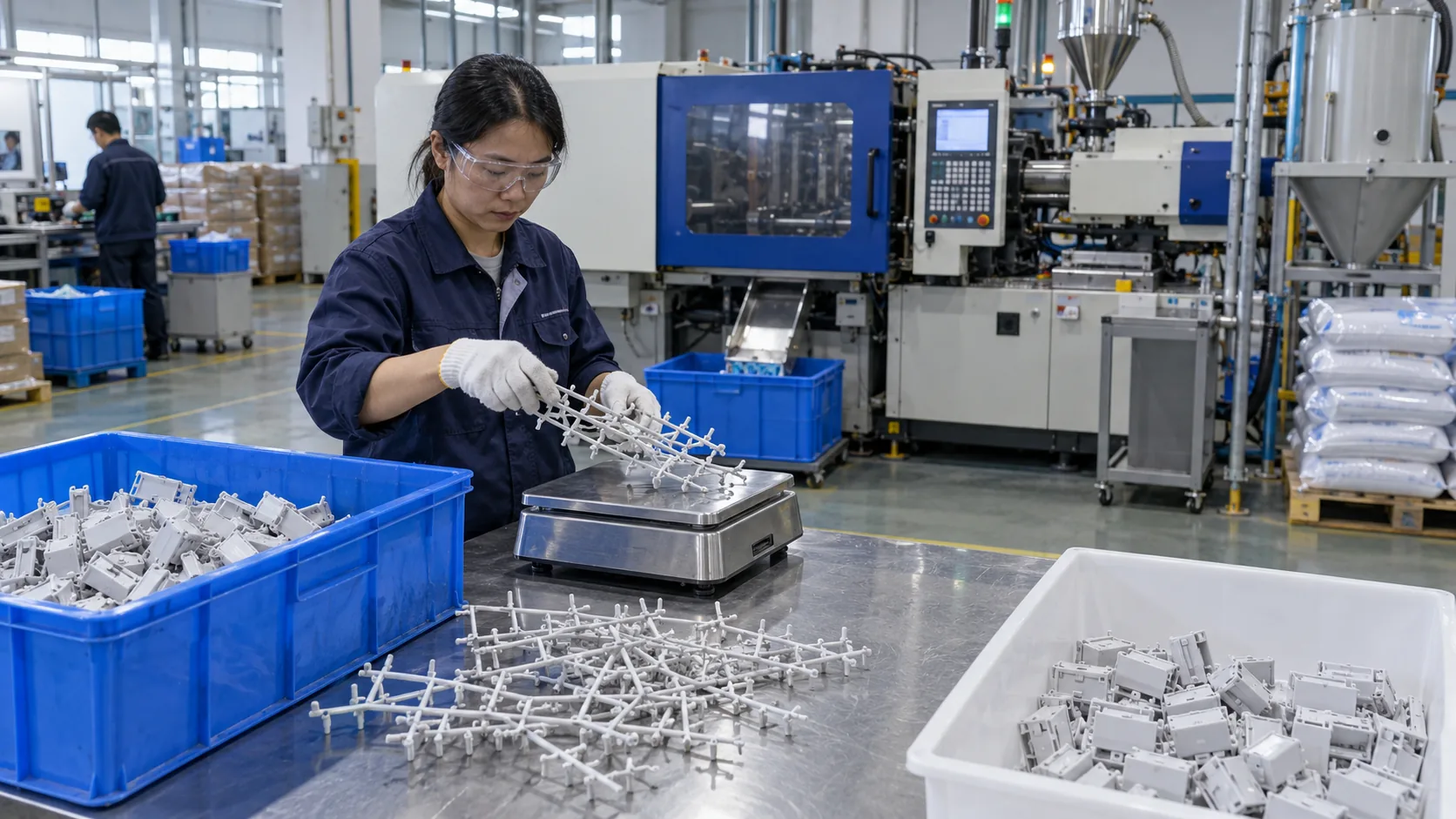
Now follow every kilogram carefully. Regrind does not become free material. It may need separation, grinding, labeling, controlled blending, drying, conveying, testing, and traceability. Some applications or customer specifications restrict recycled content. Mixed colors, foreign resin, dust, or excessive heat history can also block reuse.
Record these waste-path facts:
- Runner mass from an approved mold concept
- Scrap and startup rates by material or color
- Allowed regrind percentage and approval owner
- Labor and equipment used for separation or grinding
- Disposal, resale, or recycling route for rejected material
Value reusable runners after recovery yield and handling. Use a separate value when regrind cannot return into saleable parts.
Action recommendation: Weigh a representative runner or calculate its modeled volume before accepting any savings claim.
What belongs in a runner-waste worksheet?
| Input | Calculation use | Common mistake | Approval owner |
|---|---|---|---|
| Runner mass per shot | Annual runner mass | Estimating from part size | Tooling engineer |
| Annual shots | Repetition factor | Using part count directly | Program manager |
| Regrind recovery | Net material loss | Treating all runner as reusable | Quality and material teams |
| Handling cost | True recovery expense | Ignoring labor and equipment | Operations and finance |
5. What Happens During Color or Material Changes?
Color change depends on flow-path design, dead spots, gate style, resin, and shutdown discipline. Cold runners expose fresh solid material each cycle, while barrel and nozzle still need purging. Hot runners add heated volume that must clear.
Changeover exposes hidden flow-path pockets. Old pigment can remain near plugs, transitions, tips, or low-flow areas. Difficult manifolds consume purge resin and press time. Approval should come from trial evidence.
Map each planned change:
- Light to dark and dark to light colors
- Natural resin to filled or pigmented grades
- Material family changes allowed by equipment rules
- Maximum accepted speck or streak level
- Purge quantity, time, and verification samples
Short color runs may favor cold runners or a quick-change hot-runner design. Stable single-color production creates a different equation.
Action recommendation: Include a representative worst-case color-change trial in validation when changeover performance affects capacity.
Which changeover pattern favors which approach?
| Production pattern | Main risk | Likely direction | Validation request |
|---|---|---|---|
| One resin and color | Low change frequency | Hot-runner case strengthens | Stable startup sample run |
| Frequent dark-to-light changes | Residual pigment | Cold runner or quick-change hot runner | Purge mass and time record |
| Many short campaigns | Lost uptime | Simpler flow path may help | Campaign-level capacity model |
| Strict cosmetic surface | Specks and streaks | Either system needs evidence | Approved visual limit and sample plan |
6. Which System Better Supports Part Quality and Gate Strategy?
Runner type cannot guarantee part quality. Gate location, size, balance, cooling, venting, resin, and process settings still govern results. Hot runners can place direct gates beyond a parting-line runner's reach. Valve gates may support controlled opening or cleaner vestige targets. Cold runners can offer natural balance and visible runner evidence.
Gate strategy comes before hardware enthusiasm. A location that fills well may mark a cosmetic surface. Another may hide vestige yet create weld lines, trapped gas, or uneven packing. Multi-cavity tools need balanced delivery.
Review these quality links:
- Gate position versus cosmetic and functional zones
- Fill balance across each cavity
- Gate vestige and automatic separation needs
- Weld-line position, venting, and trapped-air risk
- Packing path before gate freeze
- Thermal influence near each hot nozzle
Simulation can compare locations, while engineering still judges access, appearance, mechanism conflicts, and production limits.
Action recommendation: Approve runner type only after gate marks, fill pattern, and cavity balance receive documented review.
What should a part-quality review compare?
| Review item | Cold-runner question | Hot-runner question | Acceptance evidence |
|---|---|---|---|
| Gate location | Can runner reach suitable gate? | Can direct drop fit and cool correctly? | Approved gate drawing |
| Balance | Are runner paths naturally balanced? | Does manifold deliver balanced melt? | Cavity comparison plan |
| Vestige | How will gate separate? | Is tip or valve mark acceptable? | Cosmetic boundary sample |
| Packing | When will gate freeze? | Does thermal control stay stable? | Process and part-weight study |
7. How Do Maintenance and Downtime Differ?
Cold-runner tools need cleaning, gate repair, vent care, cooling service, and motion maintenance. Hot runners add heaters, thermocouples, connectors, cables, insulation, nozzle tips, seals, manifolds, and controllers. Components can remain hot after power removal. Review broader runner-system cost and maintenance trade-offs against actual volume and service capability.
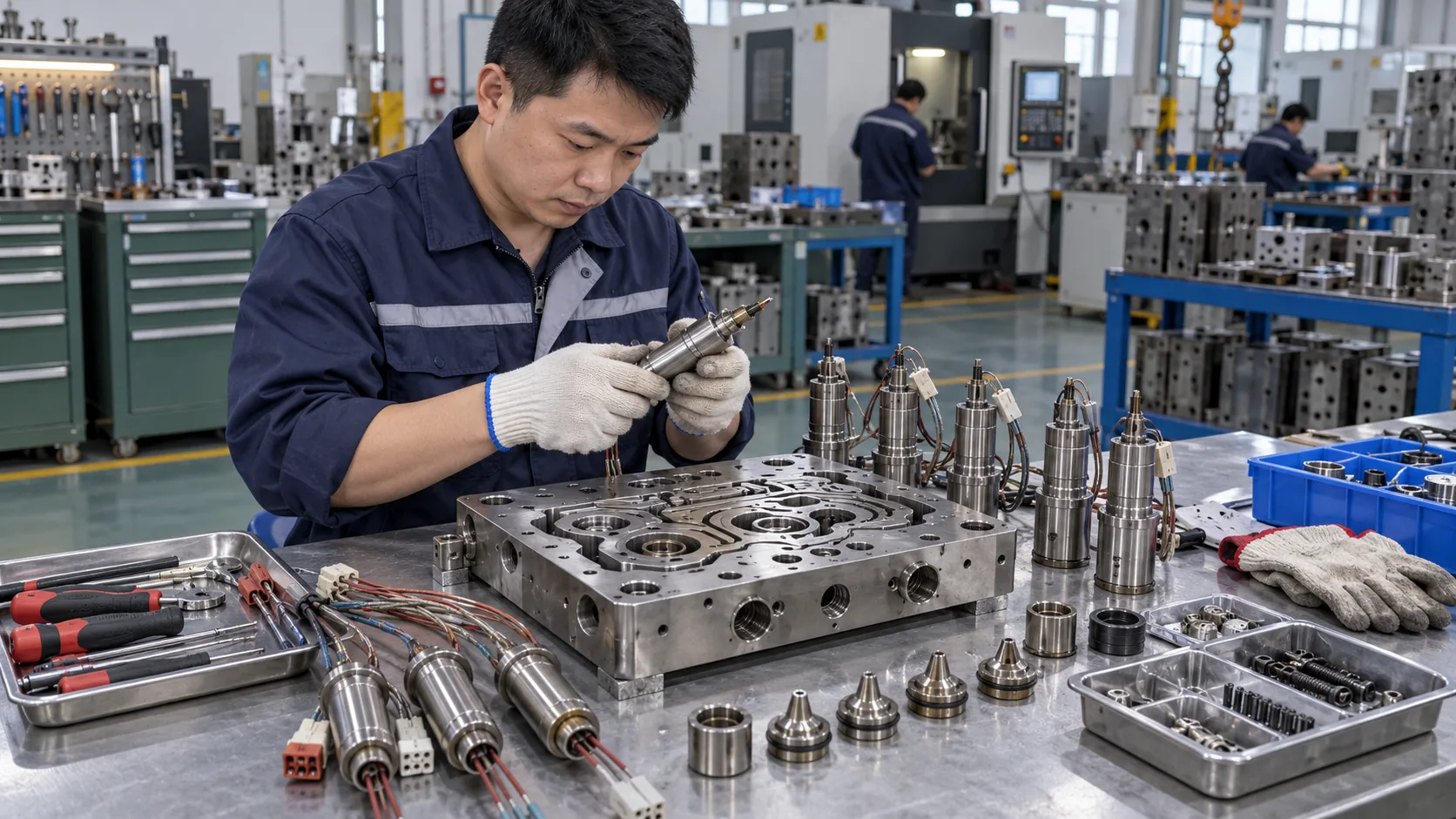
Downtime has two price tags. One covers parts and technician hours. Another covers missed output during electrical, thermal, leakage, or tip diagnosis. Spares need trained people and safe procedures.
Build a support plan covering:
- Preventive inspection interval and recorded checks
- Controller compatibility at every planned plant
- Critical spares by part number and location
- Safe heating, cooling, lockout, and disassembly steps
- Internal skill level plus external service response
- Cleaning method for leaked or degraded resin
Cold runners can wear around gates or parting surfaces. Simplicity lowers component count without removing maintenance ownership.
Action recommendation: Price one realistic failure event and confirm who can restore production before selecting a hot runner.
How should maintenance capability affect selection?
| Maintenance area | Cold runner | Hot runner | Buyer check |
|---|---|---|---|
| Routine access | Direct runner and gate access | Heated system may need controlled teardown | Written service procedure |
| Failure modes | Wear, damage, blockage | Adds heater, sensor, wire, seal, and leakage risks | Fault tree and spares list |
| Skill need | Standard mold service | Electrical and thermal diagnosis | Named trained role |
| Restart work | Clean and set process | Heat zones, purge, and verify | Restart acceptance record |
8. How Can You Calculate Hot-Runner Payback?
Payback compares added investment with recurring net savings. Start with annual runner material avoided. Add measured reductions in separation, grinding, drying, conveying, or cycle burden. Subtract energy, service, spares, purge material, and expected downtime. Divide hot-runner premium by annual net savings.
Keep every assumption clearly visible. Quotations may use different cavities, cycles, gates, or service scopes. Compare one approved demand scenario with identical inputs.
The model should contain:
- Hot-runner premium over comparable cold-runner tooling
- Annual runner kilograms genuinely avoided
- Net material value after approved recovery credit
- Measured handling and secondary-process burden
- Changeover loss and startup scrap
- Annual maintenance, spares, and controller cost
- Capacity value from any validated cycle difference
Run sensitivity cases for demand, resin price, uptime, and scrap. Count cycle savings only after engineering evidence supports them.
Action recommendation: Approve hot-runner payback only when finance, engineering, and production accept each input owner.
Which inputs make a payback model credible?
| Input | Conservative basis | Sensitivity case | Evidence |
|---|---|---|---|
| Tool premium | Comparable mold scope | Higher service package | Itemized quotations |
| Material savings | Net runner loss | Resin-price range | Runner mass and reuse policy |
| Operating savings | Measured handling | Labor-rate range | Current process observation |
| Added annual cost | Service plus downtime | Failure-frequency range | Maintenance plan and history |
9. What Should an RFQ State Before Tool Design Starts?
A runner-system RFQ should describe production conditions alongside geometry. CAD and drawings omit annual shots, campaign length, change sequences, regrind rules, target press, controls, maintenance skill, and financial hurdle. Missing inputs create different supplier assumptions.
A clean quote starts with shared boundaries. Request a recommendation plus an alternate when both systems remain viable. Each proposal should show gates, runner mass, cavities, heated volume, controls, service access, assumptions, and validation.
Send these RFQ inputs:
- Controlled 3D model and 2D drawing revision
- Exact resin grade, filler, color list, and supplier guidance
- Annual volume, campaign size, and program duration
- Regrind permission plus traceability rules
- Cosmetic zones, gate limits, and automatic degating needs
- Target machines, available controls, utilities, and plant location
- Trial, measurement, changeover, and capacity acceptance criteria
Ask for calculated runner mass and a payback range instead of a generic waste claim.
Action recommendation: Freeze all commercial assumptions in a signed concept sheet before detailed mold design begins.
What should pass the RFQ approval gate?
| RFQ field | Why it changes runner choice | Required output | Sign-off role |
|---|---|---|---|
| Demand and campaign | Sets repetition and changeovers | Shot-count model | Program and finance |
| Resin and regrind | Sets thermal and waste limits | Material assumption sheet | Material and quality |
| Gate and appearance | Sets feasible feed layout | Marked gate concept | Product engineering |
| Plant support | Sets downtime exposure | Controller, spares, service plan | Production and maintenance |
10. Which Runner System Fits Your Program?
Choose a hot runner when stable volume, valuable runner loss, suitable resin, limited changeovers, acceptable gating, and capable maintenance create defensible payback. Choose a cold runner when demand remains uncertain, campaigns stay short, changes occur often, or simple service outweighs avoided runner mass.
Some programs need one more calculation. A hybrid concept, reduced cold runner, insulated sprue, or different cavity plan may resolve conflicting needs. Keep assumptions under revision control.
Before approval:
- Compare matched concepts and cavity counts.
- Confirm resin guidance with its supplier.
- Record runner mass, purge plan, and service scope.
- Run payback under low, expected, and high demand.
- Assign validation and change owners.
Action recommendation: Send suppliers one controlled RFQ package and request a side-by-side technical and economic response before authorizing steel.
Frequently Asked Questions
- Q1: Does a hot runner always reduce cycle time? No. Cycle time depends on part cooling, mold design, process settings, ejection, and automation. Count a reduction only after engineering analysis or controlled trials support it.
- Q2: Can every resin run through a hot-runner system? No universal approval applies. Review grade, temperature range, residence behavior, filler, color, and shutdown rules with suppliers.
- Q3: Is cold-runner regrind always acceptable? No. Product requirements, customer rules, color, contamination control, heat history, and material properties can limit or prohibit regrind.
- Q4: Which option works better for frequent color changes? Cold runners often simplify clearing, though suitable hot-runner designs can perform well. Validate purge mass, time, and cosmetic acceptance.
- Q5: What data supports a reliable payback estimate? Use tool premium, annual shots, runner mass, net resin cost, approved recovery, handling, purge, maintenance, downtime, and validated cycle effects.